
Industrial & Warehouse Roofing in Fairfield, CA
Large low-slope roofs for warehouses, distribution centres and manufacturing plants across Solano County, scheduled around your operation rather than ours.
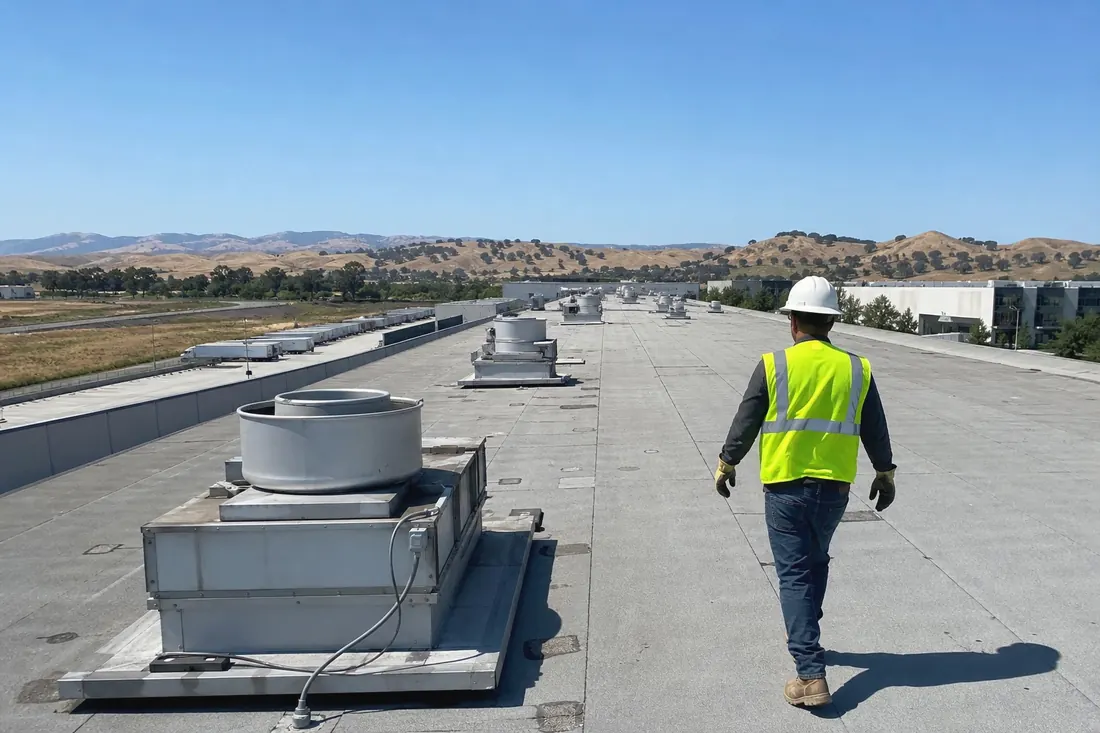
Industrial roofing in Fairfield is a different job from commercial roofing on a retail pad, and the difference is scale and operations. A distribution warehouse roof runs to hundreds of thousands of square feet, carries dense rooftop plant, and sits above inventory or production that does not stop because a roofer turned up. The scale is real. The Napa Logistics Park alone is designed for roughly 1.9 million square feet across four warehouses, including a single 700,000 square foot building, and drainage flow paths, expansion joints and zoned uplift calculations all behave differently at that size.
That changes what matters. Drainage becomes an engineering calculation rather than a detail. Wind uplift governs at corners and perimeters because there is nothing upwind of an isolated warehouse. Phasing becomes a logistics exercise in its own right. This page covers how we approach those buildings and who we are usually talking to when we do.
Who this is for
Warehouse and distribution operators, manufacturers and process facilities, industrial property owners, facility managers responsible for a single site, and property managers or commercial real estate owners running a portfolio.
Those buyers ask different questions from a shop owner with a leak. They want to know what the roof will cost across a capital cycle, how much of the operation stops while you are on it, and what evidence you can hand them for a budget request. We build scopes and reports around that.
What makes a large industrial roof different
Drainage flow paths get long. On a plate running to several hundred thousand square feet, water can travel a considerable distance before it reaches an outlet, so a small slope irregularity partway along that route ponds a substantial area. Drain capacity and overflow provision need real calculation rather than a rule of thumb, because a large plate holding water it cannot shed carries serious structural dead load.
Thermal movement matters more. A roof that size expands and contracts substantially between a cold winter morning and a hot Fairfield afternoon, which makes expansion joint design a primary consideration rather than something inherited unexamined from the previous assembly.

Wind exposure on isolated buildings
Industrial buildings usually sit on open ground with nothing to break the airflow, and Fairfield sits in the path of the Delta breeze that runs through San Pablo and Suisun Bays before squeezing through the gap at Collinsville. Sustained afternoon wind on an exposed roof is a year-round condition here rather than a storm event.
Uplift pressures at corners and perimeters are substantially higher than in the field of the roof, so the fastening plan gets zoned to match rather than applied uniformly. On the most exposed sites we specify fully adhered assemblies, and edge metal and coping get engineered rather than selected from a catalogue.
Rooftop plant and penetrations
Industrial roofs carry dense mechanical equipment, and every curb, duct, pipe and conduit is a penetration. Across commercial roofing the overwhelming majority of leaks originate at those details rather than in the field membrane.
The recurring problem is other trades. Mechanical, refrigeration, telecoms and solar contractors all have legitimate reasons to be up there and none of them are roofers. Unauthorised penetrations flashed to their own standard are a leading cause of leaks and of voided manufacturer warranties. The rule worth enforcing is that any new penetration is flashed by the roofing contractor as a condition of roof access.
Systems that suit industrial buildings
TPO is the default on large distribution plates. Big uninterrupted fields with relatively few penetrations are exactly where its economics and installation speed are strongest, and it meets the Title 24 cool roof requirement without a separate step. PVC takes over wherever the process exhausts fats, oils or chemicals onto the roof.
Metal appears on sloped and architectural elements and on older industrial stock, where a re-screw with oversized fasteners often restores weathertightness for a fraction of replacement cost. Restoration coatings deserve serious consideration at this scale, because the gap between roughly $3 to $6 per square foot for a coating and $6.50 to $15 for replacement becomes a capital decision rather than a saving.
Working around an operation
Almost no industrial building needs to shut down. Work is sequenced in sections sized so each one can be opened, completed and tied off watertight within a working day, and on a distribution building that sequencing usually follows the racking and dock layout rather than a simple grid.
Over process and controlled environments the constraint is air quality rather than water. We avoid open flame and hot asphalt above cleanroom, laboratory or food production space entirely and specify self-adhered or single-ply systems instead, planned into whatever maintenance window the facility allows.
Inspection and capital planning
On a very large plate a walking inspection covers a small fraction of the roof, so coverage gets planned against a gridded roof plan with targeted inspection of drains and their catchments, perimeter and corner zones, expansion joints and equipment areas. Moisture scanning is the only practical way to find saturated insulation before it reaches the interior.
Findings are referenced to grid positions so they can be compared year on year and taken into a budget meeting. If you manage several buildings, that reporting is often worth more than the inspection itself. Our inspection and maintenance pages cover the detail.
The services behind industrial & warehouse roofing
This page is the overview. Each of these has its own page with process, options, cost factors and local conditions.
TPO Roofing
Heat-welded single-ply membrane, and the easiest path to Title 24 cool roof compliance.
See TPO details →PVC Roofing
Grease and chemical resistant membrane. The specification of record for restaurants and food processing.
See PVC details →Commercial Metal Roofing
Standing seam, retrofit and re-screwing, with a published 40 to 60 year service life.
See metal roofing details →Commercial Roof Replacement
Full tear-off and re-cover for low-slope roofs on warehouses, business parks and retail centres.
See roof replacement details →Preventive Roof Maintenance
Scheduled inspections and drain clearing. The NRCA puts maintained roofs at 21 years against 13.
See maintenance details →Commercial Roof Inspections
Condition assessments, infrared moisture surveys and due diligence reports you can act on.
See inspection details →Roof Coatings & Silicone Restoration
Silicone restoration that extends an aged but sound roof for roughly half the cost of replacement.
See coating details →Related overview pages
Fairfield Superior Commercial Roofing provides industrial & warehouse roofing across Fairfield and Solano County. Licensed and insured, open 24 hours a day.
Industrial & Warehouse Roofing questions we get asked in Fairfield
Can you re-roof a warehouse without shutting it down?
Almost always. The roof is opened in sections sized so each can be completed and made watertight within a working day, and the sequence follows your racking and dock layout so the areas most sensitive to a water event are done in the most settled conditions.
Tell us early which zones hold the highest value inventory and which docks cannot be blocked, and the phasing gets built around that rather than around our convenience.
How do you find a leak on a roof that size?
Not by walking it. Infrared or capacitance moisture scanning maps where water is actually held in the assembly, and the investigation is directed at those areas and confirmed with water testing.
It matters at this scale because water travels a long way along deck flutes and between insulation boards before it drops. The interior symptom can be a considerable distance from the entry point, which is why repairs aimed at the ceiling stain so often fail on large plates.
What does an industrial roof cost?
Published 2026 ranges put most commercial systems between $5.50 and $15.00 per square foot installed, and on a plate measured in hundreds of thousands of square feet a small per-square-foot difference becomes a very large number.
That is exactly why restoration deserves a look before replacement. Where a moisture survey comes back dry and the details are repairable, a coating at roughly $3 to $6 per square foot is a fundamentally different capital conversation.
Do you handle roof work on manufacturing and process buildings?
Yes, with method restrictions. Over controlled environments we avoid open flame and manage odour carefully, because fumes reaching air handling is a considerably more expensive problem than the leak itself.
We are a roofing contractor rather than a process specialist. We plan around your maintenance windows and your facilities team's requirements, and we will say so plainly if a scope needs input we cannot provide.
Which areas do you cover for industrial roofing?
Fairfield is our home market. We also cover the Highway 12 logistics corridor in Suisun City, the I-505 distribution corridor in Vacaville, the Benicia Industrial Park, Mare Island in Vallejo, agricultural processing in Dixon, and the very large distribution plates in American Canyon.
Each of those markets has its own page covering local building stock and exposure conditions.
Get a written scope for your industrial roofing project
Free assessment with core cuts, a moisture survey and photographs, on any commercial building in Fairfield or Solano County.