
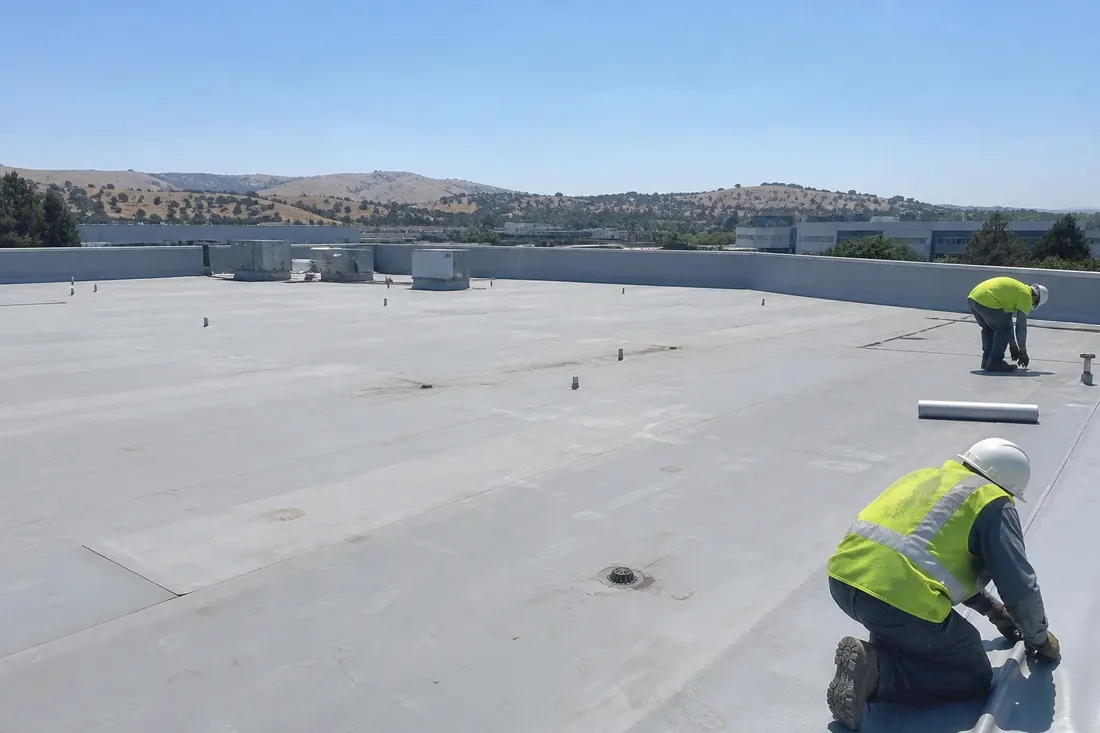
Commercial Flat Roofing in Fairfield, CA
Low-slope roofing for commercial and industrial buildings across Fairfield and Solano County. Installation, replacement, repair and restoration.
Commercial flat roofing in Fairfield covers almost every roof you can see from the Cordelia and Highway 12 corridors, because low-slope is what commercial construction uses. A flat roof is not actually flat. It is built with a shallow fall, usually a quarter inch per foot or less, and everything about how it performs comes down to whether water leaves that surface quickly enough.
This page is the starting point if you know you have a low-slope commercial roof and are not yet sure which system or which service you need. It covers how the systems compare, how to tell repair from replacement, and what drives cost and timeline. Where a section names a specific system, it links to the page that covers that system properly rather than repeating it here.
What counts as a flat or low-slope commercial roof
Roofing is divided by slope rather than by building use. Low-slope generally means anything under 2:12, which is where membrane systems take over from shingles and tiles. Above that you are into steep-slope territory and different products entirely.
Almost every warehouse, distribution building, retail centre, office block and light manufacturing plant in Solano County sits on a low-slope roof. That is why the specification questions are always the same three: which membrane, how is it attached, and where does the water go.
Building types we work on
Warehouses and distribution buildings, where the roof plate is large and the drainage flow paths are long. Retail centres and multi-tenant pads, where the roof is shared and the exhaust from one tenant can affect the membrane above another. Light manufacturing and process buildings, where rooftop plant is dense and someone is on the roof most weeks. Offices and mixed commercial, where the roof is usually simpler but the interior damage from a leak is more expensive.
If your building is a warehouse, distribution facility or manufacturing plant, the dedicated industrial and warehouse roofing page covers the operational side in more detail.

Common problems on Fairfield flat roofs
Standing water is the one we are called to most. A low-slope roof is engineered to drain, and water still sitting on it more than 48 hours after rain has stopped meets the generally accepted definition of ponding. It accelerates membrane breakdown, adds structural dead load and concentrates the dirt and growth that attack seams.
After that it is details rather than field membrane. Curbs, skylights, pipe penetrations, drains and perimeter edge metal account for the large majority of commercial roof leaks. The open field of a machine-welded membrane rarely fails on its own. Wind is the third factor here, because Fairfield sits in the path of the Delta breeze and uplift concentrates at roof perimeters and corners.
Choosing a flat roof system
There is no single best low-slope system, only the right one for what your building does. TPO is the general purpose choice for warehouse and distribution roofs and meets California cool roof requirements straight off the roll. PVC resists the animal fats and cooking oils that destroy other membranes, which makes it the specification of record for restaurants and food processing.
EPDM offers strong value on large simple roof fields and has the longest documented field record of the single-ply systems. Modified bitumen and built-up roofing trade elegance for redundancy, which is worth real money on roofs that take heavy foot traffic. Metal carries the longest published service life at 40 to 60 years but suits sloped and architectural applications rather than dead-flat plates.
Repair, recover, restore or replace
These are four different projects and the honest answer usually comes from a moisture survey rather than a sales conversation. Repair is right while the membrane still has meaningful service life and the problem is localised. Restoration coating suits an aged but structurally sound and dry roof, costs roughly half of replacement and adds a published 10 to 20 years.
Recover installs a new system over the existing one where the deck is sound and there is only one existing layer. Full replacement becomes the economical answer once moisture scans show saturated insulation across a meaningful area or the membrane is past its published service life.
What drives cost on a flat roof
Published 2026 industry pricing puts most commercial systems between $5.50 and $15.00 per square foot installed, and where a specific building lands inside that band has more to do with the details than the membrane. Tear-off versus recover is the largest single variable, because removing and disposing of an existing built-up roof adds both labour and landfill cost.
Insulation is the next factor, since Title 24 assembly requirements frequently mean more polyiso than the old roof carried. After that it is deck condition, how many rooftop penetrations there are, and whether the wind exposure calls for a fully adhered assembly rather than mechanical attachment. A number quoted over the phone without a survey is close to meaningless.
Timeline and disruption
A straightforward 20,000 to 30,000 square foot single-ply replacement typically runs one to three weeks. Roofs crowded with HVAC curbs, skylights and screen walls take longer, because the detail work rather than the field membrane drives the schedule.
Almost no commercial building needs to close. Work is sequenced so only the section above a given area is open at a time, and each section is tied off watertight before the crew leaves. The local constraint is season: Fairfield gets roughly 18 to 19 inches of rain a year and almost all of it lands between November and March, so the May to October window is where flat roof work belongs.
Keeping a flat roof alive
The National Roofing Contractors Association reports that a commercial roof under a maintenance program reaches about 21 years of service while the same roof without one typically fails around 13. That is eight years on an asset costing six figures to replace, and it is the highest return decision available to most facilities managers.
In practice it comes down to clearing drains before the wet season, catching a lifting seam while it is small, and keeping unauthorised trades from making their own penetrations. Our maintenance programs and inspection reports cover both.
Which flat roof system suits your building?
Four questions. The result is the specification we would start from on a building like yours, with the reasoning shown rather than hidden. It is a starting point for a conversation, not a quote, and nothing replaces core cuts and a moisture survey on the actual roof.
Answer all four to see a recommendation.
The services behind commercial flat roofing
This page is the overview. Each of these has its own page with process, options, cost factors and local conditions.
TPO Roofing
Heat-welded single-ply membrane, and the easiest path to Title 24 cool roof compliance.
See TPO details →PVC Roofing
Grease and chemical resistant membrane. The specification of record for restaurants and food processing.
See PVC details →EPDM Roofing
Synthetic rubber membrane with the longest documented field record in commercial roofing.
See EPDM details →Modified Bitumen & Built-Up Roofing
Multi-ply asphalt systems with redundancy built in, for roofs that take heavy foot traffic.
See modified bitumen details →Roof Coatings & Silicone Restoration
Silicone restoration that extends an aged but sound roof for roughly half the cost of replacement.
See coating details →Flat Roof Leak Repair
Finding where the water actually enters, and correcting the drainage that put it there.
See leak repair details →Commercial Roof Replacement
Full tear-off and re-cover for low-slope roofs on warehouses, business parks and retail centres.
See roof replacement details →Related overview pages
Fairfield Superior Commercial Roofing provides commercial flat roofing across Fairfield and Solano County. Licensed and insured, open 24 hours a day.
Commercial Flat Roofing questions we get asked in Fairfield
What is the best flat roof system for a commercial building in Fairfield?
For most warehouse, distribution and general commercial roofs, TPO. It handles the Fairfield heat load, meets the Title 24 cool roof requirement without a separate coating step, and its heat-welded seams outperform adhesive ones.
The exceptions are worth knowing. If the building exhausts grease onto its own roof, you want PVC. If the roof takes heavy foot traffic, multi-ply modified bitumen gives you redundancy a single-ply cannot.
How long does a commercial flat roof last?
Published industry ranges put TPO at 20 to 30 years, PVC at 15 to 30, EPDM at 20 to 35, modified bitumen at 10 to 30 and metal at 40 to 60.
Where your roof lands inside its range depends far more on maintenance and attachment quality than on the brand of membrane. Drainage is the single biggest variable, because a roof that ponds for four months a year is working much harder than one that sheds water.
Can a flat roof be repaired instead of replaced?
Often, and it is worth establishing before you budget for replacement. Repair is the right economic choice while the membrane still has service life and the problem is confined to details rather than the whole assembly.
The evidence that decides it is a moisture survey and a core cut. If scans show saturated insulation across a meaningful area, continued repair is money spent delaying an inevitable replacement.
Why does water sit on our flat roof?
Usually because the drainage design has very little margin and something has restricted it. A blocked strainer, a drain set fractionally above the deck plane, or deck deflection between structural members will all pond water on a roof built with minimal fall.
None of those are membrane failures and none are fixed by patching. The corrections are drain retrofits, crickets and tapered insulation. Our flat roof leak repair page covers the diagnosis in detail.
Do you work on flat roofs outside Fairfield?
Yes. We cover Suisun City, Vacaville, Vallejo, Benicia, Dixon and Rio Vista across Solano County, plus American Canyon and Napa in Napa County.
Each city has its own page covering the local building stock, wind exposure and drainage conditions, because a marsh-edge roof in Suisun City and a Delta corridor roof in Rio Vista are genuinely different problems.
Get a written scope for your flat roofing project
Free assessment with core cuts, a moisture survey and photographs, on any commercial building in Fairfield or Solano County.